Back to Projects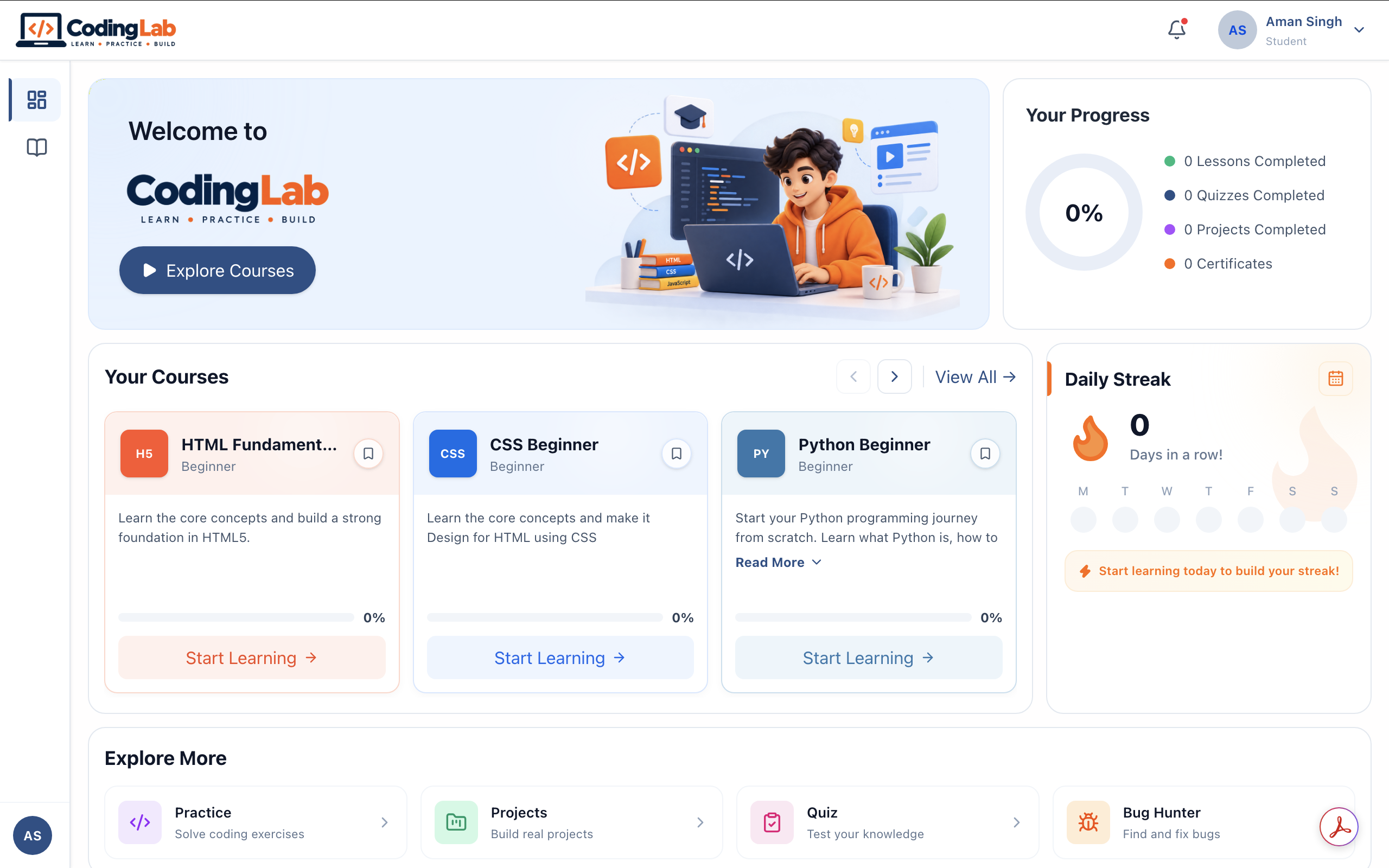
⚡ Frontend OwnedCompany ProductionPrivate Product
Interactive Learning Case Study
Coding Lab — Interactive Coding Learning Platform
A coding-learning platform built around learning by doing, not only watching.
React.jsJavaScriptTailwind CSSREST APIsResponsive UI
CRM Interface
01 / 01
Role
Frontend Developer — Primary Frontend Ownership
Organization
Educerns Technologies Pvt Ltd
Timeline
Production
Product Access
Private & Permission Based
Product Overview
A coding platform focused on learning by doing.
Coding Lab provides structured learning experiences across technologies and development paths including HTML, CSS, Java, Python, Full Stack Development and Web Development. Students move from foundational concepts toward more advanced practical work.
The platform goes beyond notes and recorded videos. Students practice concepts, interact with learning games, complete challenges and build projects before entering a work-experience section designed to make project execution feel closer to real company development. Completing the required learning journey can lead to course certification.
Structured Learning
Courses guide learners from foundational concepts toward progressively more advanced programming topics.
Learning by Practice
Students repeatedly apply concepts through practice instead of depending only on passive learning material.
Project-Based Learning
Challenges and projects allow students to use concepts in more practical development scenarios.
Progress Intelligence
Student progress and activity provide visibility into completion, engagement and stronger or weaker learning areas.
Core Capabilities
Learning experiences beyond notes and videos.
The major workflows and product experiences I worked on across this application.
Coding Courses
Structured learning paths across different programming languages and development areas.
Notes
Learning material helps students understand concepts before practical application.
Video Learning
Video-based learning complements written course material.
Practice
Practical coding exercises reinforce concepts through repeated application.
Coding Games
Game-oriented learning creates a more engaging way to reinforce programming concepts.
Challenges
Students complete challenges that test understanding beyond standard lessons.
Projects
Project-based learning turns individual concepts into practical development work.
Work Experience
Students complete projects through a workflow designed to feel closer to development inside a company.
Progress Tracking
Course progress is tracked throughout the learning journey.
Activity Tracking
Student activity provides insight into engagement with different learning areas.
Strength & Weakness
Learning behavior can help identify areas where a student performs strongly or needs additional practice.
Certification
Students completing required course activities can receive a course-completion certificate.
Student Learning Journey
From learning the basics to practical work experience.
01Learn foundational concepts
02Study notes and videos
03Practice coding
04Use game-based learning
05Complete challenges
06Build practical projects
07Enter simulated work experience
08Track progress and performance
09Complete course requirements
10Receive certification
Student Intelligence
Understanding how each student is progressing.
Learning is not only about completing lessons. Tracking activity helps reveal how students engage with practice, challenges and projects and where additional improvement may be needed.
Course progress
Student activity
Practice participation
Challenge completion
Project completion
Strong learning areas
Weak learning areas
Overall completion
My Frontend Ownership
I worked across the product, not only isolated screens.
My responsibility covered product workflows, frontend structure, reusable interfaces and continuous implementation rather than only one individual feature.
Frontend architecture
Course-learning interfaces
Practice experiences
Game-based learning UI
Challenge interfaces
Project workflows
Student progress UI
Activity tracking experiences
Work-experience interfaces
Course-completion flow
Certification experiences
Responsive production UI
Behind the Build
The thinking, difficulties and learning behind the product.
Every project added something different to how I understand products, users and frontend engineering.
01
Planning & Structure
Before building individual learning screens, I first mapped the complete student journey: what a beginner sees, how a learner practices, when difficulty should increase, where projects appear and how course completion should be measured. I used AI to help organize the learning flow and challenge assumptions before implementation.
02
Difficulty I Faced
The hardest part was making the platform feel like a learning journey instead of a collection of disconnected modules. Games, practice, challenges, projects and work experience needed to feel connected to student progress.
03
What I Learned
This project improved my understanding of engagement-driven products. I learned that educational software needs more than technically correct features; students need visible progress, small achievements, practice opportunities and enough variation to stay engaged.
04
Human & User Behavior
While working on Coding Lab I thought much more about student motivation. Someone learning programming can easily become frustrated when difficulty increases too quickly. Practice, games, challenges, projects and progress visibility help create smaller wins and encourage the learner to continue.
05
How I Used AI
I used AI for brainstorming learning sequences, project structures, possible challenge ideas, module organization and edge cases. It helped me explore different educational flows quickly, while the final structure remained aligned with actual product requirements.
06
How It Improved Me
Coding Lab strengthened my ability to think about product psychology. I started thinking not only about whether a feature works, but whether it motivates the user to return, continue and feel progression.
Engineering Perspective
Challenge, approach and product impact.
01
Challenge
Traditional learning platforms often stop at notes and videos, which is not enough for students who need repeated practice and practical exposure to genuinely learn programming.
02
Solution
The product combines conceptual learning with practice, games, challenges, projects and simulated work experience so students repeatedly apply what they learn instead of only consuming content.
03
Impact
Coding Lab provides students a structured journey from foundational learning to practical coding experience while continuously tracking progress, activity and performance throughout the course.
More Work
Explore more products I've worked on.
Production applications, frontend-owned products and collaborative work across different business domains.