Back to Projects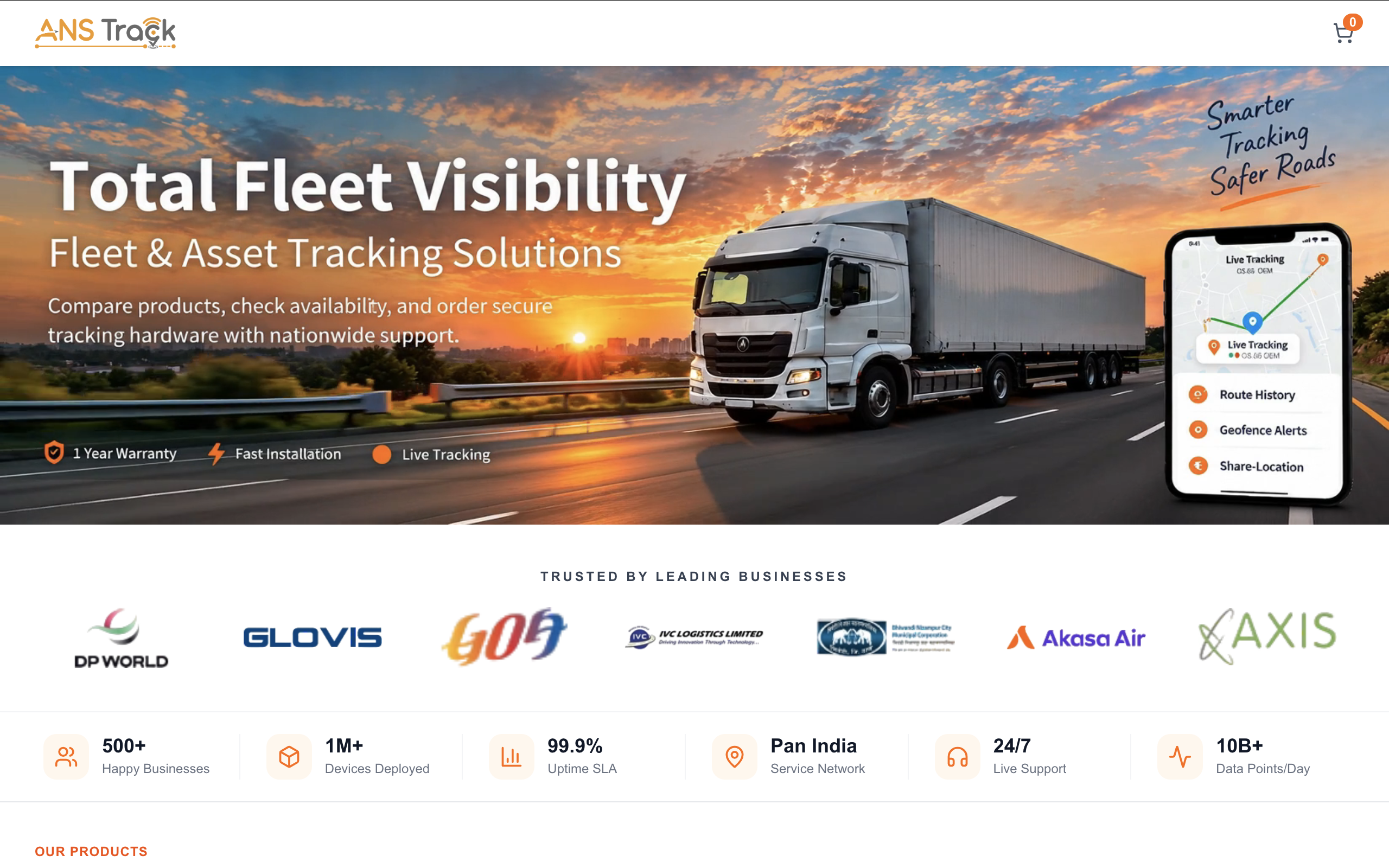
⚡ Frontend OwnedLive E-Commerce
Shopify Learning & Commerce Case Study
ANS Tracknology — Custom Shopify Storefront
Turning an unfamiliar platform into a custom e-commerce experience through research and experimentation.
ShopifyLiquidJavaScriptHTML5CSS3Responsive Design
Visit Live ProjectCRM Interface
01 / 01
Role
Frontend / Shopify Developer — End-to-End Storefront
Organization
ANS Tracknology
Timeline
Production
Product Access
Public Product
Product Overview
Building a custom commerce experience by learning an entirely new platform.
The requirement was to create an e-commerce storefront for ANS Tracknology, a company selling GPS tracking products. Shopify was selected as the commerce platform, which meant I had to work in an ecosystem that was different from the React applications I was already comfortable building.
I initially tried available free themes but found them visually limited for the type of storefront I wanted. Premium themes were available, but instead of stopping there I researched whether Shopify allowed custom-coded themes. That exploration introduced me to Liquid and led to the creation of my own custom theme, Glamorous Moment.
Platform Exploration
I first understood Shopify's theme system, template structure and how data is exposed to Liquid.
Custom Theme
Rather than remaining dependent on a standard free theme, I created a custom storefront theme named Glamorous Moment.
Commerce Integrations
Payments, product ratings and reviews were integrated using capabilities and applications available in the Shopify ecosystem.
Responsive Storefront
The storefront was designed to work consistently across product, collection and responsive shopping experiences.
Core Capabilities
The storefront features I explored and delivered.
The major workflows and product experiences I worked on across this application.
Custom Theme
A custom Shopify theme built through Liquid, HTML, CSS and JavaScript.
Product Pages
Dedicated product presentation experiences for GPS tracking products.
Collections
Structured collection experiences for browsing related products.
Cart Experience
Shopping interactions connected with Shopify's cart and checkout workflow.
Payments
Payment requirements integrated into the commerce experience.
Ratings
Product rating functionality introduced through Shopify-compatible integrations.
Reviews
Customer review experiences added using tools available inside the Shopify ecosystem.
Responsive Design
Storefront layouts adapted for mobile, tablet and desktop shopping.
Project Learning Journey
From exploring an unfamiliar platform to delivering a production product.
01Started with Shopify free themes
02Identified visual and flexibility limitations
03Explored available premium themes
04Researched custom Shopify theme development
05Learned Liquid and Shopify theme structure
06Created Glamorous Moment
07Integrated commerce functionality
08Optimized and shipped the live storefront
My Frontend Ownership
I worked across the product, not only isolated screens.
My responsibility covered product workflows, frontend structure, reusable interfaces and continuous implementation rather than only one individual feature.
Storefront planning
Shopify theme research
Custom theme development
Liquid templates and sections
Responsive layouts
Product presentation
Collection experiences
Cart interactions
Payment integration support
Rating integration
Review integration
Production storefront improvements
Behind the Build
The thinking, difficulties and learning behind the product.
Every project added something different to how I understand products, users and frontend engineering.
01
Planning & Structure
Because Shopify was new to me, I did not begin by immediately modifying theme code. I first used documentation, research and AI to understand Shopify concepts, Liquid structure, sections, templates and the typical e-commerce flow before deciding how to build the custom storefront.
02
Difficulty I Faced
The biggest difficulty was moving away from the mental model I used in React. I had to understand what Shopify already controls, what Liquid renders on the server side and where JavaScript should be introduced without fighting the platform.
03
What I Learned
This was one of my most valuable learning projects because it proved that my frontend skills were not limited to one framework. I learned Shopify, Liquid, theme development and how a commerce platform connects product data, payments, reviews and customer-facing experiences.
04
Human & User Behavior
E-commerce made me think differently about user behavior. Visitors need to understand a product quickly, trust the store and reach important actions without confusion. That influenced how I thought about product presentation, trust sections, ratings, reviews and checkout-related interactions.
05
How I Used AI
AI helped me understand unfamiliar Shopify concepts faster, compare implementation options and create learning plans for Liquid and theme architecture. I treated it as a research assistant rather than blindly copying code, because platform-specific behavior still required testing inside Shopify.
06
How It Improved Me
The project strengthened my confidence in entering unfamiliar technologies. Instead of saying a project was outside my stack, I learned to research the platform, understand its rules and connect my existing frontend knowledge to a completely different ecosystem.
Engineering Perspective
Challenge, approach and product impact.
01
Challenge
This project pushed me outside my usual React-focused environment. Shopify introduced Liquid, theme architecture, platform conventions and an ecosystem that worked very differently from the frontend applications I had previously built.
02
Solution
Instead of accepting the limitations of available free themes or immediately depending on an expensive paid theme, I researched Shopify custom theme development and built the storefront through custom Liquid sections, templates and frontend code.
03
Impact
Delivered a custom live e-commerce storefront while expanding my experience beyond React into Shopify, Liquid, commerce integrations and platform-specific frontend development.
More Work
Explore more products I've worked on.
Production applications, frontend-owned products and collaborative work across different business domains.